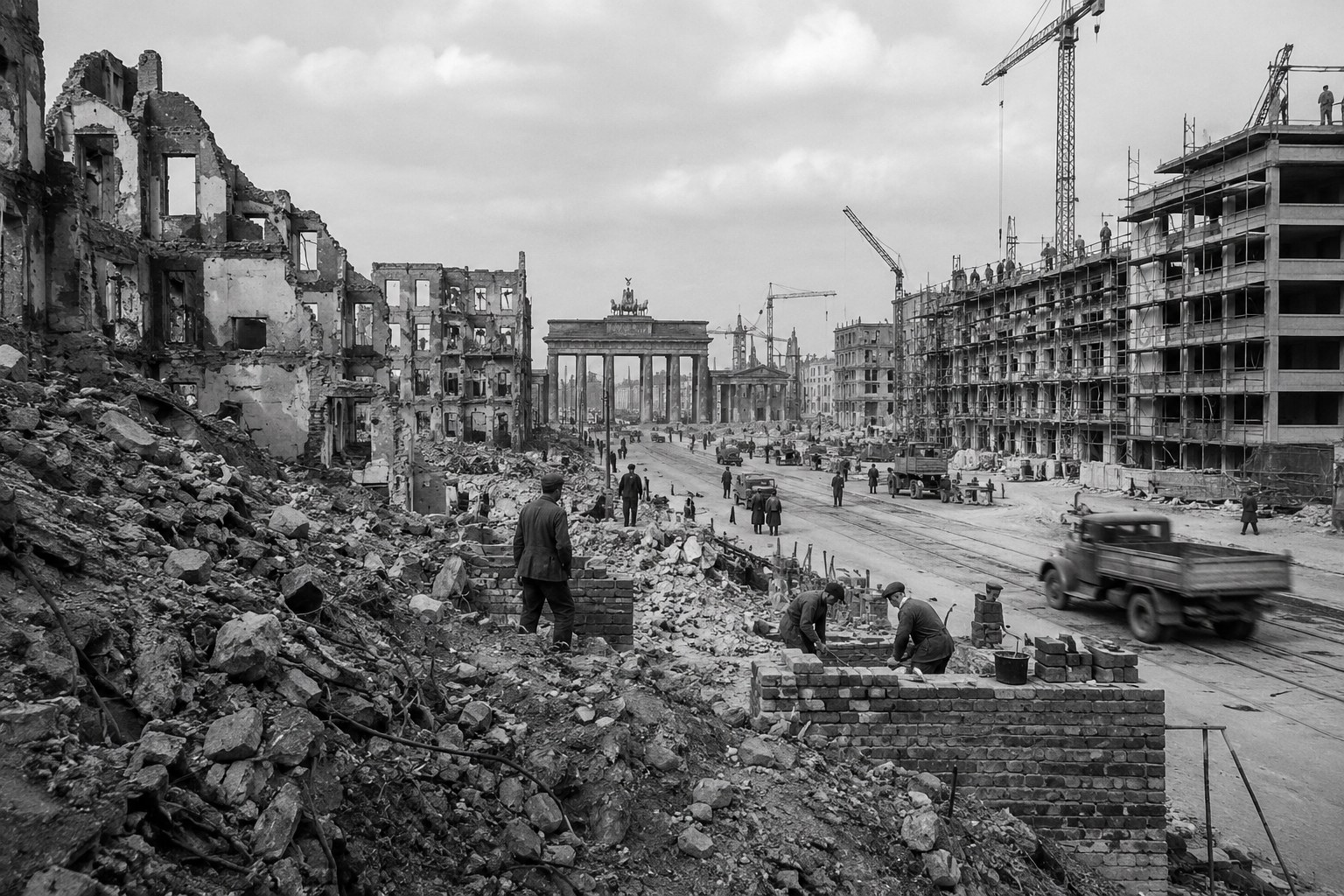
In 1945, both cities held the same material: broken stone, broken people, and a continent's worth of American dollars arriving with strings attached. What they built from it diverged so completely that the divergence itself became a kind of ideology.
London rebuilt slowly, and it rebuilt up — tower blocks, brutalist estates, the Barbican rising out of a levelled financial district like a fortress that had decided to stay. Berlin split before it could rebuild, and the split became the rebuilding. The file exists to document what happened when the same instrument, offered as recovery, produced two entirely different arguments.
The same capital. Two cities. Two arguments in concrete.
London: Building for a Promise
The city treated concrete as a civic promise: housing as a right, brutalism as the visual language of a welfare state trying to prove it was permanent. The bombing had been total. The rebuilding insisted it would be too.
The postwar Labour government understood the housing programme as a moral obligation, not a political strategy. You do not ask people to die for their country and then send them home to damp rooms and shared toilets. The blocks that rose across Britain through the 1950s and 1960s were built in that spirit — for the people who would live in them.
Berlin: Building for a Verdict
Berlin split before it could rebuild, and the split became the rebuilding. Two currencies, two aid packages, two competing claims to the same rubble. The Marshall Plan financed the western half explicitly to outbuild the eastern half — reconstruction as propaganda with a foundation.
Plattenbau went up on one side of a line that hadn't finished being drawn yet, engineered less for its inhabitants than for the people watching from across a wall that didn't exist yet but was already being planned for.
One city built for its residents. The other built for its audience.
The Same Money, Two Arguments
Here is the paradox the file exists to document: the same instrument — American capital, offered as recovery — produced a city that built itself as an argument for the state, and a city that built itself as an argument against the other city's state. London's brutalism was sincere. Berlin's was a rebuttal poured in concrete, aimed at a neighbour rather than a need.
Both cities called it reconstruction. Only one of them was rebuilding for the people who would live there. The other was rebuilding for the people who would be watching.
That distinction is the whole of the Marshall Plan's paradox. Aid given freely still arrives with an argument attached.